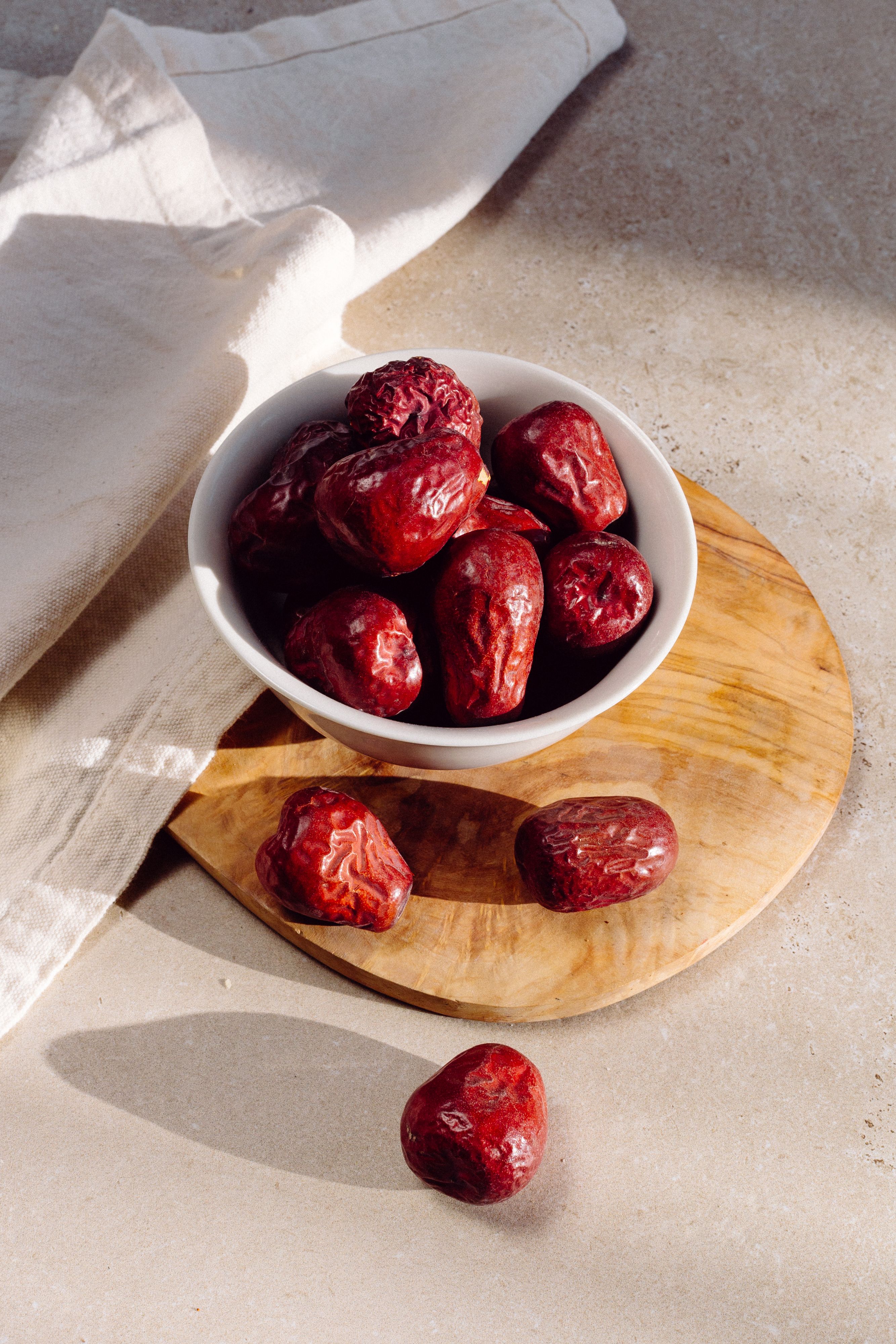
Dà Zăo - Jujube 大枣
Jujubae Fructus
Meet Dà Zăo
Some herbs you come to through books. Some through illness. And some - the lucky ones - you discover at a farmer's market on an ordinary afternoon, bite into without knowing what you're holding, and think: where has this been all my life?
That's how Dà Zăo and I found each other.
I was in college when I first encountered jujube at a farmer's market, introduced to me simply as Chinese dates. I tried one expecting something date-like and found something entirely its own: subtly sweet, with a texture I loved immediately. I was a fan before I ever knew it was medicine. Now, years later and deep into my TCM training, jujube shows up constantly in my kitchen - in my Ginger Jujube Cider, in my Jujube Chocolate Bliss Balls, simmered into broths, steeped into teas. It is one of those rare herbs that doesn't feel like medicine at all. It feels like a treat. And then you learn what it's actually doing in your body, and it feels like a gift.
Dà Zăo (the jujube, or Chinese date) is one of the most beloved and widely used herbs in the entire Chinese Materia Medica. It appears in more classical formulas than almost any other single herb, and for good reason. Warm, sweet, nourishing, and harmonizing, it is the kind of herb that makes everything around it work better. In TCM we might say it is generous by nature. It gives, it protects, it smooths the way for others.
The Basics
Pharmaceutical name: Jujubae Fructus
Botanical name: Zizyphus jujuba
Taste: Sweet
Temperature: Warm
Channels entered: Spleen, Stomach
Classical text: Shennong Bencao Jing (one of the oldest and most foundational texts in Chinese medicine)
Sweet herbs in TCM are nourishing and tonifying - they build, they replenish, they harmonize. Warm herbs bring gentle heat to cold or deficient conditions, supporting circulation and metabolic function. Together, sweet and warm describe an herb that feeds and restores, which is exactly what Dà Zăo does.
It enters the Spleen and Stomach, the digestive center of TCM, where it nourishes and supports the body's ability to transform food and qi into vitality. But its reach extends far beyond digestion, as we'll see below.
What It Does
Tonifies Spleen Qi
When the Spleen is deficient, we feel it everywhere. We might have a poor appetite, loose stools, fatigue, or that bone-deep tiredness that doesn't resolve with rest. Dà Zăo is a gentle but effective Spleen tonic, helping to rebuild the digestive foundation that everything else in the body depends on. Think of it as replenishing the soil so that everything planted there can grow.
Nourishes Blood
Dà Zăo has a significant blood-nourishing function, making it valuable for patterns of Blood deficiency, including pallor, dizziness, heart palpitations, poor memory, dry skin and hair, and the kind of anxiety or restlessness that comes not from excess but from emptiness. When there isn't enough Blood to anchor the mind, the Shen (or Spirit) becomes unsettled. Dà Zăo addresses this at the root.
Calms the Shen
Speaking of Shen, Dà Zăo has a gentle but meaningful calming effect on the spirit. It appears in Gān Mài Dà Zăo Tāng (Licorice, Wheat, and Jujube Decoction), one of TCM's most beautiful and poignant formulas, traditionally used for patterns of emotional distress, restlessness, and what the classics describe as "visceral agitation," which is a kind of grief-tinged anxiety that can't quite be named. The formula is as simple as it sounds and as profound as it gets.
Harmonizes Harsh Herbs
This is one of Dà Zăo's most important and distinctive functions. Some herbs in the Chinese Materia Medica are powerful but harsh: strong movers, aggressive drainers, potentially toxic substances that have been carefully processed but still carry significant force. Dà Zăo's sweet, harmonizing nature softens these edges, protecting the middle jiao from damage and making formulas more tolerable and effective. In this function it can even substitute for Gān Căo (licorice root), which brings us to something worth mentioning.
The Three Sweets — A Teaser
Dà Zăo has a special partnership. In countless classical formulas you'll find three herbs appearing together: Shēng Jiāng (fresh ginger, our first herb in this series), Dà Zăo, and Gān Căo (licorice root). Together they are sometimes referred to as the "three sweets" or the "magic three" - a trio that harmonizes the middle jiao, protects the Spleen and Stomach, increases the digestibility of the overall formula, and helps the body receive the medicine more smoothly. They are the foundation that makes so many formulas work. Gān Căo is coming up in this series, and when it does, we'll bring all three together properly. Stay tuned. 🌿
Harmonizes Nutritive and Protective Qi
Like its partner Shēng Jiāng, Dà Zăo also helps harmonize the relationship between Nutritive Qi (Ying Qi) and Protective Qi (Wei Qi), the interior nourishing force and the exterior defensive force. When these fall out of sync, vulnerability to illness and a host of exterior pattern symptoms can arise. This is another reason the Shēng Jiāng and Dà Zăo pairing appears so frequently together in formula design.
How To Use It
Standard dose: 3-12 pieces (or 10-30g)
Form: Whole dried dates, simmered in water or decoctions, added to soups and broths, or eaten directly as food medicine
Jujubes are one of the most food-friendly herbs in the entire Materia Medica. They require no special preparation and can be eaten directly or added to almost any recipe. For medicinal use, simmering them in water or broth for 20-30 minutes releases their sweetness and medicinal constituents fully. Please note that in order to fully extract all medicinal constituents, it is generally advised to slice through the outer skin of the jujube so that the simmering water can fully penetrate the herb.
A note on related herbs: Hóng Zăo (red date) is essentially the same fruit and the variety most commonly found in mainstream markets — if you've seen red dates at an Asian grocery store, that's Hong Zao. Hēi Zăo (black date) is the same fruit that has been smoked, which gives it a deeper, more complex flavor. All three are used medicinally, though Dà Zăo is the classical standard.
In The Kitchen
Jujube is one of the most versatile food-medicine ingredients you can keep in your pantry. A few favorites from The Winding Path kitchen:
- Ginger Jujube Cider: Fresh ginger, jujube, cinnamon stick, and Asian pear simmered together into a deeply warming, immune-supporting drink. One of the first recipes on this site, and one of my personal favorites for cold season.
- Jujube Chocolate Bliss Balls: Jujube as the base of a no-bake chocolate dessert, rolled in black sesame or chia seeds. Medicine that tastes like a treat.
- Add to broths and soups: A handful of jujubes simmered into any broth adds subtle sweetness, nourishing blood-building properties, and Shen-calming support. Particularly lovely in chicken or bone broth.
- Eat them directly: A few jujubes as an afternoon snack is a completely legitimate food medicine practice. Sweet, satisfying, and quietly nourishing.
A Word of Caution
Dà Zăo is gentle and well-tolerated by most people, but there are situations where it should be avoided or used carefully:
- Dampness and food stagnation: Dà Zăo's sweet, cloying nature can worsen conditions involving accumulation of dampness, food retention, or bloating in the epigastric region. If you tend toward heaviness, sluggish digestion, or phlegm-damp conditions, use cautiously and consult a practitioner.
- Toothache from cavities: The sweetness of jujube can aggravate dental pain from cavities, a small but practical caution worth knowing.
- Phlegm-heat cough: If a cough is accompanied by yellow or green phlegm and heat signs, Dà Zăo's warming, nourishing nature is not appropriate and could worsen the condition.
As always, consult a qualified healthcare provider before using any herb therapeutically, particularly if you are pregnant, nursing, or managing an existing health condition.
Practitioner's Corner
For those with a TCM background, a few things worth noting:
The classical indications from the Shennong Bencao Jing are worth sitting with: Dà Zăo "governs pathogenic Qi in the Heart and Abdomen, settles the middle, nourishes the Spleen, assists the 12 channels, unblocks the 9 orifices, and harmonizes the 100 medicinals." That last phrase, "harmonizing the 100 medicinals," speaks directly to its role as a formula harmonizer, a function that appears across an extraordinary range of classical prescriptions.
The note that it "treats running piglet Qi" is also worth flagging. Running Piglet (奔豚, Bēn Tún) is a classical pattern describing a sensation of Qi rushing upward from the lower abdomen toward the chest and throat. It is associated with fear, cold, and Kidney or Heart disharmony. Dà Zăo's ability to settle and anchor makes it relevant here, particularly in formulas like Guì Zhī Tāng where it supports the harmonization of Ying and Wei and prevents rebellious Qi from rising.
Pharmacologically, Dà Zăo has demonstrated antineoplastic, sedative, and hepatoprotective activity, research that aligns well with its classical functions of nourishing, calming, and protecting.
Its appearance in the formula record is remarkable in breadth: Guì Zhī Tāng, Gān Mài Dà Zăo Tāng, Zhì Gān Căo Tāng, Shí Quán Dà Bǔ Tāng, Guì Pí Tāng, Xiǎo Chái Hú Tāng, and dozens more, spanning exterior-releasing, interior-warming, tonifying, and harmonizing categories alike. Few herbs travel so freely across formula families.
Standard dose is 3-12 pieces or 10-30g in decoction.
This post is part of The Winding Path Single Herb Series. Next up: Gān Căo - and the story of the Three Sweets comes together.
For educational purposes only. Please consult a qualified healthcare provider before using herbs therapeutically.