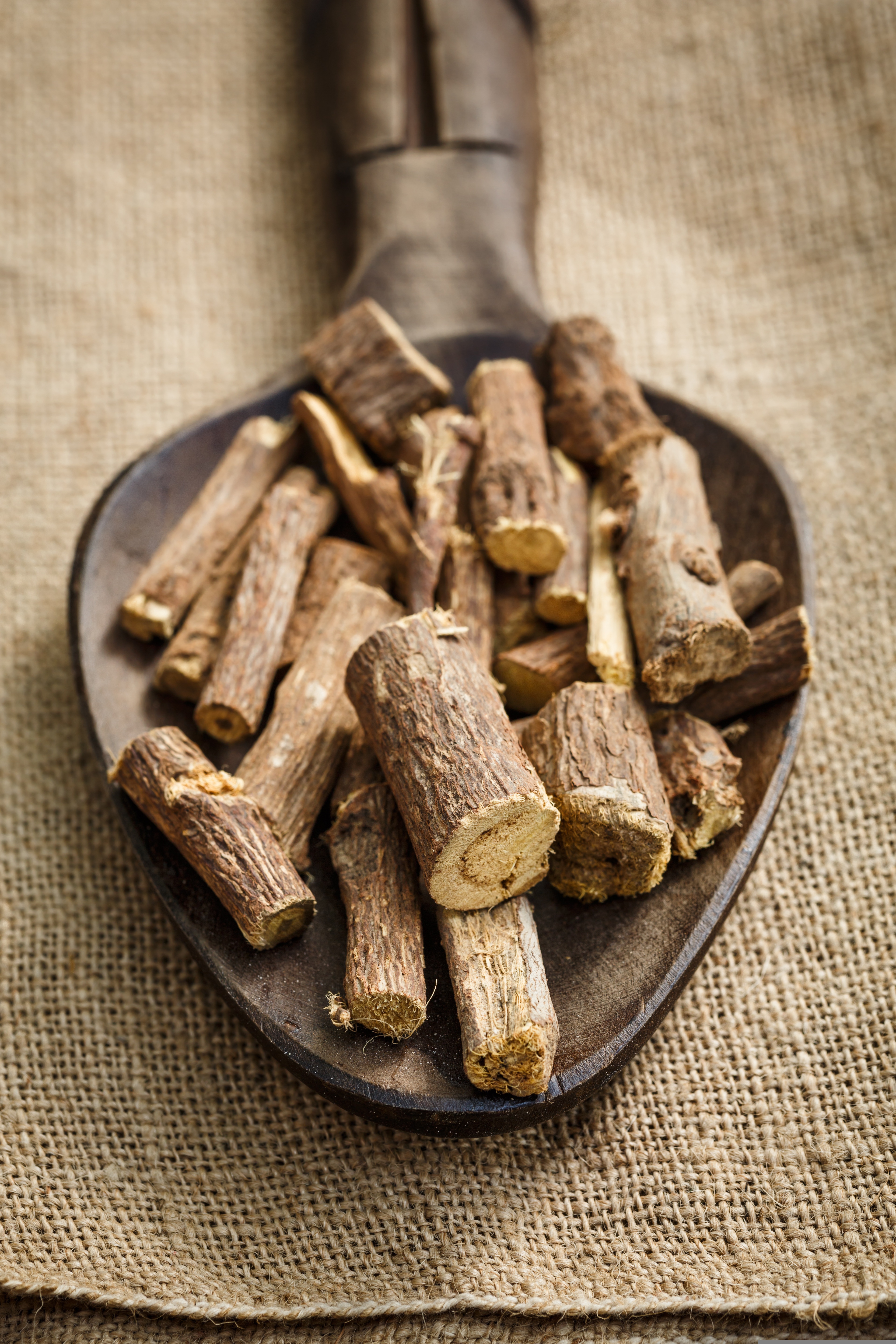
Gān Căo — Licorice Root 甘草
Glycyrrhizae Radix
Meet Gān Căo
Every great ensemble has one. The steady presence in the background who never seeks the spotlight, never steals the scene, but without whom nothing quite works the way it should. In music it's the bassist. In a kitchen it's salt. In Traditional Chinese Medicine, it's Gān Căo.
Licorice root is not a glamorous herb. It won't dazzle you with dramatic actions or exotic properties. What it will do is show up reliably, quietly, and in more formulas than almost any other substance in the entire Chinese Materia Medica. It harmonizes. It protects. It makes everything around it work better and taste better and land more gently. It is, in the truest sense, the herb that holds everything together.
I use Gān Căo constantly: in formulas, in teas, in clinical study. Once you start recognizing it in the classical literature you can't stop seeing it everywhere. It's in Guì Zhī Tāng. It's in Má Xìng Shí Gān Tāng. It's in Zhì Gān Căo Tāng, which is named after it. It's in the formula for pulse irregularities and the formula for sore throat and the formula for abdominal spasm and the formula for emotional distress. It travels across every category, every organ system, every clinical context - always harmonizing, always protecting, always quietly essential.
Its Chinese name says it all: 甘草. Gān means sweet. Căo means herb. It is, simply, the Sweet Herb. And it earns that name. Licorice root is approximately 50 times sweeter than sugar, a fact you'll never forget the first time you taste it raw.
The Basics
Pharmaceutical name: Glycyrrhizae Radix
Botanical name: Glycyrrhiza uralensis, inflata, or glabra
Classical text: Shennong Bencao Jing
Taste: Sweet
Temperature: Neutral (raw) to Warm (honey-fried)
Channels entered: All 12 channels, with particular affinity for the Heart, Lung, Spleen, and Stomach
That last point deserves emphasis. Most herbs enter two, three, maybe four channels. Gān Căo enters all twelve. This is part of what gives it such extraordinary range as a harmonizer; it can travel anywhere in the body, accompanying other herbs wherever they need to go and smoothing the way.
Identification tip: always taste this herb to confirm it. The sweetness is unmistakable: dramatically, almost shockingly sweet for something that looks like a plain dried root. Raw Gān Căo should be yellowish-white inside. Honey-fried Zhì Gān Căo will be blackish-brown and sticky. More on that distinction in the Practitioner's Corner.
What It Does
Tonifies Spleen Qi and Augments Qi
Like its partners Shēng Jiāng and Dà Zăo, Gān Căo supports the Spleen and middle jiao, addressing poor appetite, loose stools, fatigue, and the shortness of breath that comes with Qi deficiency. Its sweet flavor is inherently nourishing and building, gently restoring what has been depleted.
Moistens the Lungs and Stops Cough
Gān Căo has a significant moistening quality that makes it valuable for cough and difficult breathing. Its sweet, neutral nature is soothing to irritated lung tissue and helps calm rebellious Lung Qi. It appears in formulas for both acute respiratory conditions and chronic lung patterns, often working alongside other herbs to create a more complete respiratory response.
Relieves Toxicity
This is one of Gān Căo's most remarkable functions. It has a broad detoxifying action which is useful for fire toxin conditions like sore throats, carbuncles, and skin sores, as well as for clearing the toxic effects of other herbs or accidental poisoning. In the classical literature it is said to "harmonize the 100 medicinals," meaning it mitigates the harsh or toxic properties of the herbs around it, making formulas safer and more tolerable. This is why you will find it in formulas alongside some of TCM's most powerful and potentially toxic substances.
Relieves Spasm and Pain
Combined with Bái Sháo (White Peony Root), Gān Căo becomes a potent antispasmodic. This classical pairing appears in Sháo Yào Gān Căo Tāng, one of the simplest and most effective formulas in the entire canon for abdominal cramping and muscle spasm in the legs. The combination is elegant in its simplicity and reliable in its results.
Regulates the Pulse
This is a function unique to Gān Căo among the common Qi tonics. It has a specific action on the Heart and pulse and is used in patterns of irregular heartbeat, palpitations, and pulse irregularities, particularly in the formula Zhì Gān Căo Tāng where it is the chief herb.
Harmonizes Formula Actions
Perhaps Gān Căo's most defining role in Chinese medicine is as a harmonizer - the herb that coordinates the actions of all the other herbs in a formula, reduces side effects, moderates harsh properties, and helps the formula as a whole land more gently and work more effectively. This is why it appears at the end of so many formula ingredient lists, often in a smaller dose than the other herbs, quietly doing its essential work.
A Note on Western Herbalism
This is where integrative medicine gets interesting. Western herbalists have long used licorice root as a single herb in significantly higher doses than TCM typically employs, sometimes even as a natural steroid replacement, supporting adrenal function and helping the body retain minerals. This mineral-retaining property is also why licorice can worsen hypertension with prolonged use. It encourages water retention through a mineralocorticoid-like mechanism and can also slow the body's metabolism of corticosteroids.
This is not a reason to avoid the herb, it's a reason to understand it. In the context of a balanced formula at standard TCM doses, these effects are rarely problematic. But for clients with hypertension or those on corticosteroids or digoxin, it's an important conversation to have. If water retention is a concern, combining with herbal diuretics such as Fú Líng, Zhū Líng, or Zé Xiè is a classical and sensible strategy.
Modern research has also explored Gān Căo's role in stomach ulcer treatment, which aligns well with its classical function of protecting and harmonizing the middle jiao.
We aren't alternative medicine. We are integrative medicine, and Gān Căo is a perfect example of why that distinction matters.
How To Use It
Standard dose: 2-9g in most formulas; up to 15-30g in certain specific applications
Preparation: Raw (Gān Căo) to clear heat and relieve toxicity; honey-fried (Zhì Gān Căo) to tonify the middle and Heart
Raw licorice root can be simmered in decoctions, added to herbal teas, or used in formula granules. Its sweetness makes it a natural flavor balancer in any preparation. It genuinely improves the taste of formulas that might otherwise be quite bitter or harsh.
A small piece of raw licorice root simmered into a tea is a simple and effective remedy for sore throat - soothing, anti-inflammatory, and gently detoxifying.
In The Kitchen
Gān Căo is less of a culinary herb than Shēng Jiāng or Dà Zăo, but it has its place in food medicine:
- Herbal teas and decoctions: A small piece simmered with other herbs improves flavor and adds harmonizing, protective properties to any blend
- Throat soothing tea: Gān Căo with Jú Huā (chrysanthemum) and honey makes a gentle, effective tea for sore throat and mild heat signs
- In formula cooking: Many classical food medicine recipes include a small amount of licorice root to harmonize the other ingredients and protect the Spleen, the same logic that puts it in medicinal formulas applies in the kitchen
A Word of Caution
Gān Căo is safe and well-tolerated at standard doses, but there are important cautions to know:
- Hypertension: Avoid prolonged use or high doses with high blood pressure due to its mineralocorticoid effect and tendency to promote water retention
- Dampness and bloating: Like Dà Zăo, Gān Căo's sweet nature can worsen conditions of dampness accumulation or epigastric distention. Use cautiously if digestion is sluggish or bloating is present
- Herb-drug interactions: Use caution alongside digoxin and corticosteroids; consult a qualified practitioner if these medications are involved
- Classical incompatibilities: Traditionally contraindicated with Gān Suì, Dà Jǐ, Yuán Huā, and Hǎi Zǎo. These combinations are avoided in classical formula design
- Pregnancy and nursing: Consult a qualified healthcare provider before therapeutic use
As always, this information is for educational purposes. Please consult a qualified healthcare provider before using any herb therapeutically.
Practitioner's Corner
Gān Căo vs. Zhì Gān Căo
This distinction matters clinically and the two should not be used interchangeably. Much like the relationship between Shēng Jiāng and Pào Jiāng, processing fundamentally changes the herb's nature and emphasis, not merely its intensity.
Gān Căo (raw) is neutral in temperature. Its primary strengths are clearing heat, relieving toxicity, and harmonizing formula actions. It is the better choice when heat signs are present or when the primary goal is detoxification and formula coordination.
Zhì Gān Căo (honey-fried) is warm. Processing with honey deepens its tonifying action, particularly on the Heart and Spleen. It is more strongly harmonizing, more nourishing, and better suited to deficiency patterns. It is the chief herb in Zhì Gān Căo Tāng - a formula for pulse irregularities arising from Qi and Blood deficiency - where its ability to regulate the pulse and nourish the Heart are central to the formula's mechanism.
In practice: if the formula goal is tonification and harmonization, Zhì Gān Căo. If the goal is heat-clearing, detoxification, or formula moderation, raw Gān Căo. When in doubt, knowing which preparation a classical formula specifies (and why) is always worth investigating.
Pharmacologically, Gān Căo demonstrates a remarkable range of activity: mineralocorticoid and glucocorticoid effects, anti-inflammatory, antiarrhythmic, immunomodulatory, antispasmodic, antitoxin, antibiotic, analgesic, antitussive, expectorant, antihyperlipidemic, and hepatoprotective. Few single herbs in any tradition match this breadth of documented activity, which goes some way toward explaining why it appears in so many formulas across so many categories.
The Three Sweets - The Reveal
And now, at last, we can bring all three together.
Shēng Jiāng. Dà Zăo. Gān Căo.
In the classical literature these three herbs appear together so frequently, and so purposefully, that they have earned a collective identity. They are sometimes called the "three sweets," or the "magic three," though their combined action is anything but simple. Together they harmonize the middle jiao, protect the Spleen and Stomach from the harsher herbs in a formula, increase the body's ability to receive and digest the medicine, and smooth the relationship between Nutritive and Protective Qi.
Shēng Jiāng brings warmth and dispersion - moving outward, opening, activating.
Dà Zăo brings sweetness and nourishment - building Blood, anchoring Shen, giving generously.
Gān Căo brings harmony - traveling all twelve channels, coordinating every action, holding the whole together.
They are the foundation beneath so many of TCM's greatest formulas. Guì Zhī Tāng. Xiǎo Chái Hú Tāng. Bān Xià Xiè Xīn Tāng. Countless others. Remove any one of the three and the formula shifts. Together they create something greater than the sum of their parts.
We'll explore the Three Sweets in their own dedicated post because they deserve it. But for now, having met all three, you already understand something essential about how Chinese medicine thinks. It isn't just about individual herbs and individual actions. It's about relationship. About harmony. About the whole being greater than its parts.
Which is, perhaps, what good medicine has always been about.
This post is part of The Winding Path Single Herb Series. Next up: The Three Sweets - Shēng Jiāng, Dà Zăo, and Gān Căo together at last.
For educational purposes only. Please consult a qualified healthcare provider before using herbs therapeutically.