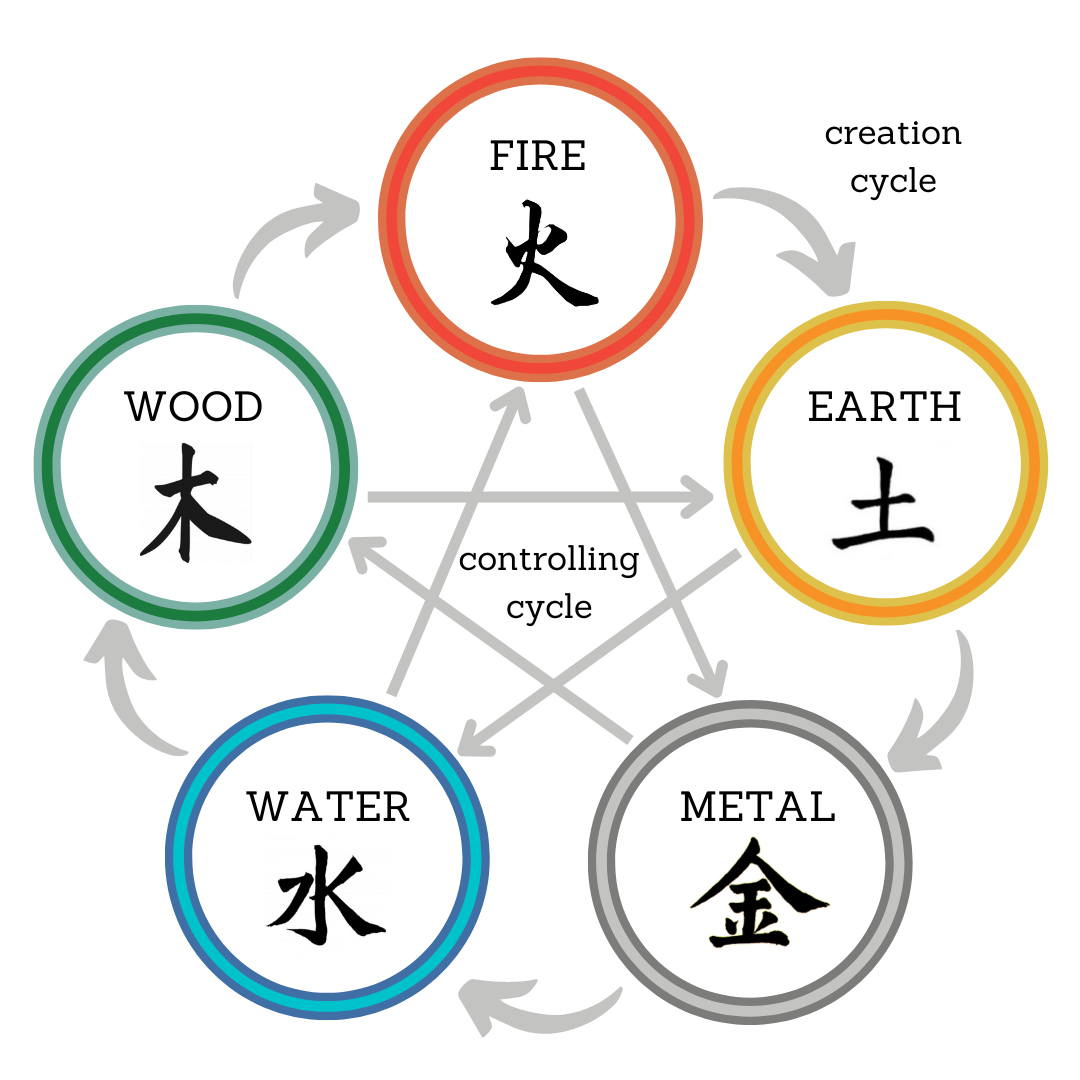
In Traditional Chinese Medicine (TCM), health is looked at through the lens of the five elements. These five elements are Wood, Fire, Earth, Metal, and Water. These elements are meant to be symbolic representations of various characteristics, seasons, etc. in the natural world that we can see within ourselves as well. These elements can be looked at individually, or in relation to one another, and their general imbalances are thought to be the base of many TCM diagnoses. This is an introduction to the five elements individually, and how they relate to TCM thinking and philosophy.
Wood (Mù) 木
Wood is represented by the image of a growing tree. Like the branches of a tree, the energy of Wood is expansive, it moves in all directions. Also like a tree, Wood bends and straightens. It is flexible and requires moisture or yin so it doesn't become brittle or dry. Its animal is the ox, and like the ox, Wood is about how we handle hardship. Wood wants planning and deliberation, and then follow through on the plans. When we don't follow through on our plans, our Wood energy can become stuck. The organ of wood is the Liver, which is prone to Qi Stagnation and Fire syndromes. In TCM the Liver is thought of as the General and the organ that stores the blood. A healthy liver means properly nourished organs, mind, and spirit. The season of Wood is Spring, when things are growing and the weather is beginning to warm. It is a time of yang coming out of yin, as the sun and warmth grow and life begins, and the quiet solitude of winter ends. The virtue of Wood is compassion, while its pathology or a sign of imbalance is a lack of compassion. The emotion of imbalance in Wood is anger. Anger causes your qi to explode upwards, creating improper flow of qi, and damaging Wood. The colors associated with Wood are green and greenish-blue, like the greenish-blue of a body of water. The flavor that helps to balance an imbalanced Wood element is the sour flavor. The acrid, pungent, or spicy flavor also embodies Wood energy, as it is a dispersing and expanding flavor. Its sound is shouting.
How balanced is your Wood element?
- Can you get through hardship and adversity?
- Do you persevere?
- Are you able to follow through on plans?
- Are you quick to anger, or do you experience explosive anger?
Fire (Huǒ) 火
Fire flares upward, and has many different forms. It can be a raging fire or smoldering embers depending on how it's tended. The animal of Fire is the horse, a creature symbolizing momentum, strength, and even desire. Like a horse, Fire can be fickle. Balanced Fire behavior is like leading the horse to the pasture with gentle guidance, and then observing it, allowing it its freedom. Imbalanced Fire behavior is like overworking the horse instead. When our Fire is balanced, we are calm, peaceful, and radiant. Fire is related to the spirit or Shen, the Heart, and the Pericardium. In TCM, the Shen is housed in the Heart, and it is because of this that the Heart should be kept empty of all desires, traumas, wants, angers, frustrations, and other emotions and things we are holding onto. We call it "keeping the Heart empty." The Heart is the Emperor, and the Pericardium is its Guard or Protector. If the Pericardium is balanced, one will feel in love with the universe. The animal of the Pericardium's fire is the dog - man's best friend and loyal protector. Dogs love selflessly and unconditionally, and they will take action to protect you. That is the message of Pericardium's fire. The color associated with Fire is red. The flavor that helps to balance imbalanced Fire is the bitter flavor. Its sound is laughter.
How balanced is your Fire element?
- How focused on wants, desires, traumas, or emotions are you?
- Do you try to manifest only good things in your life, or are you willing to accept whatever comes your way?
- Do you feel more lonely or more connected?
- How hard are you working yourself, and are you making time to take care of yourself?
Earth (Tǔ) 土
Earth is represented by the planet Earth, and also the dirt and soil that composes our landmasses. Soil looks still, but when we look closely and beneath the surface, there is lots of movement. The Earth gives and receives. When you plant a seed, that seed takes the nutrients of the soil and grows. When the plant inevitably dies, it returns to the soil, breaking down and becoming soil for the next generation of plants. This transformative property is also Earth energy. The organ of the Earth is the Spleen, and it is responsible for the transformation and transportation of qi and nutrients within the body. In TCM, the Spleen receives the refined qi taken from our air and food, then transforms them into qi for the body. When our Earth element is balanced, we can digest and assimilate anything. When our Earth element is out of balanced, we tend to become consumed with worry and overthinking. Earth is also the soil that forms the banks of the river, and so Earth represents boundaries as well as bonds. The animal of Earth is the Uroboros. It is the image of a snake eating its own tail as it makes a perfect circle. This image represents the infinite cycle of life and death, constant renewal, and change. These are all part of life, and living in harmony with life means embracing that these are all things that we will deal with and have to learn to assimilate. Earth is one of the elements that when it is aligned and balanced, we might not even be aware of it. It isn't showy or bright. It is genuine, sincerity, adaptation, and effortless action. The color associated with Earth is yellow, like the clay of the earth. The flavor that helps to balance imbalanced Earth is sweetness. Please note, this isn't the sweetness of processed sugar - that is too sweet and can harm the Earth element. Instead, natural sweetness like that found in almonds, apples, or pumpkins would be appropriate. The sound of Earth is singing, especially if the singing sounds satisfied.
How balanced is your Earth element?
- How do you receive compliments, gifts, or love? Can you receive freely, or does receiving make you uncomfortable?
- How adaptable are you? When something changes, are you able to shift, or is there rigidity?
- Do you spend a lot of time ruminating over the past?
- Do you feel comfortable and strong in your boundaries, or does having boundaries feel anxiety-inducing?
Metal (Jīn) 金
The image of metal is of a sword being forged and re-forged until is the perfect blade, properly balanced and sharp enough to cut through any obstacles. Similar to the sword, Metal is an element that changes and reverses, it contracts and expands. The organ of Metal is the Lungs, which contract and expand as we breathe. When Metal is balanced it is adaptable, flexible, and has the ability to release or let go. When it is imbalanced, it is rigid and brittle. Metal is represented by the tension before a strike, like a spring that has been wound and has all the tension stored and ready to explode out. The animal of Metal is the Tiger, an animal that carefully stalks its prey, then waits, silent and still, for the perfect moment to pounce. Metal is an element of duality, such as the desire to be an individual who is unique, but also to fit in and integrate socially. Metal's duality can also be seen in how Metal can be a powerful, dangerous sword, or a fragile, elegant necklace. Both are made of Metal, but were forged differently. The color of Metal is the blinding white of the sun gleaming off a sword about to strike. The taste that balances Metal is acrid, also known as pungent or spicy, which represents Metal's expansive nature. To represent Metal's contracting nature, the sour flavor would be appropriate. The sound of Metal is the crying associated with genuine grief.
How balanced is your Metal element?
- Are you holding onto anything, especially grief, loss, or trauma, that you need to let go of?
- How do you feel about the seasons of life, from birth to adulthood to death?
- How balanced is your contracting and expanding in your life? (Ex: Do you talk too much? Do you isolate?)
- How are your relationships? Do they feel bonded? Is there tension?
Water (Shuǐ) 水
The image of water is the river flowing down the mountain, where it eventually meets the lake. The river that cuts through the mountain is persistent. It carves the face of the mountain, given enough time. Like the river, our Water elements requires firmness and determination. At the same time, water is soft and shapeless, and so we must simultaneously hold this firmness and softness, determination and ability to flow. Water returns to the source, and our Water element asks us to return to our original and authentic selves. The organ of Water is the Kidneys, which play a large role in our water metabolism. The Kidneys are the source and storage point for our prenatal qi, or our original qi from when we are born. Strong and healthy Kidneys directly relate to the idea of us returning to our source, to our original qi. The animal of Water is the owl, a creature of the night who represents wisdom and truth. The owl is humble, and can be low to the ground. Yet they can also be firm and determined when they are successfully hunting. Balanced Water has the ability to hold a secret, while imbalanced Water has no ability to hold. The secret would be spilled. Balanced Water is humble, while imbalanced Water is arrogant, driven by ego, and lacking in patience. The color of Water is black, like soot or a crow's wing. The taste that balances Water is salty. Not overly salty, but a brackish type of salty flavor. The sound of Water is peaceful groaning or sighing, or deep breathing.
How balanced is your Water element?
- How is your ability to hold a secret?
- How do you listen to others? Are you still? Are you waiting for your turn to speak?
- How is your willpower? Do you feel determined to meet your goals?
- How is your humility versus arrogance? Are you truly okay with being wrong or not knowing? Can you turn to others for guidance?
- Do you truly know who you are? If so, do you live that life every day?